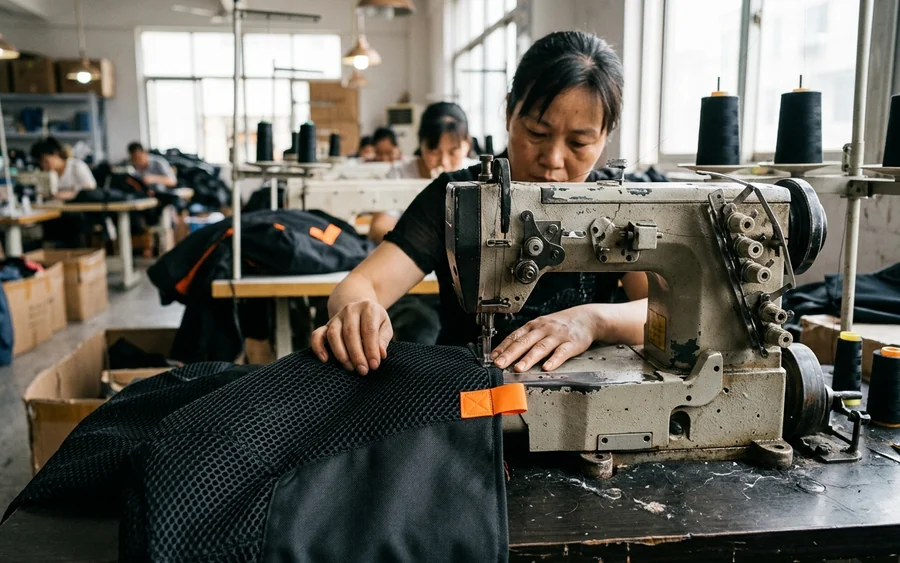
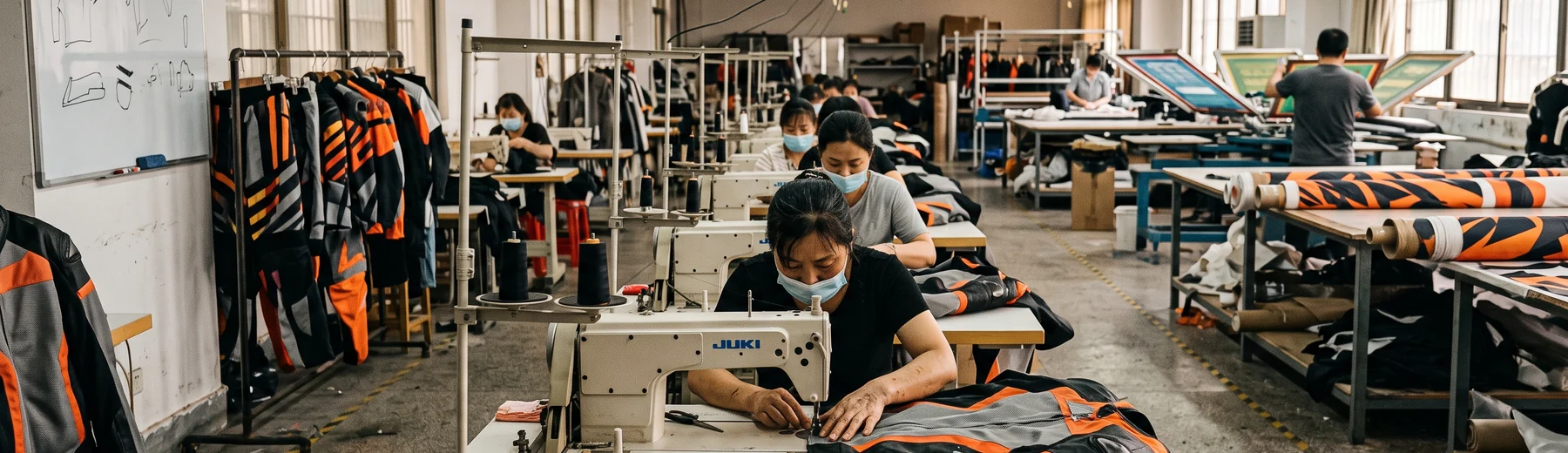
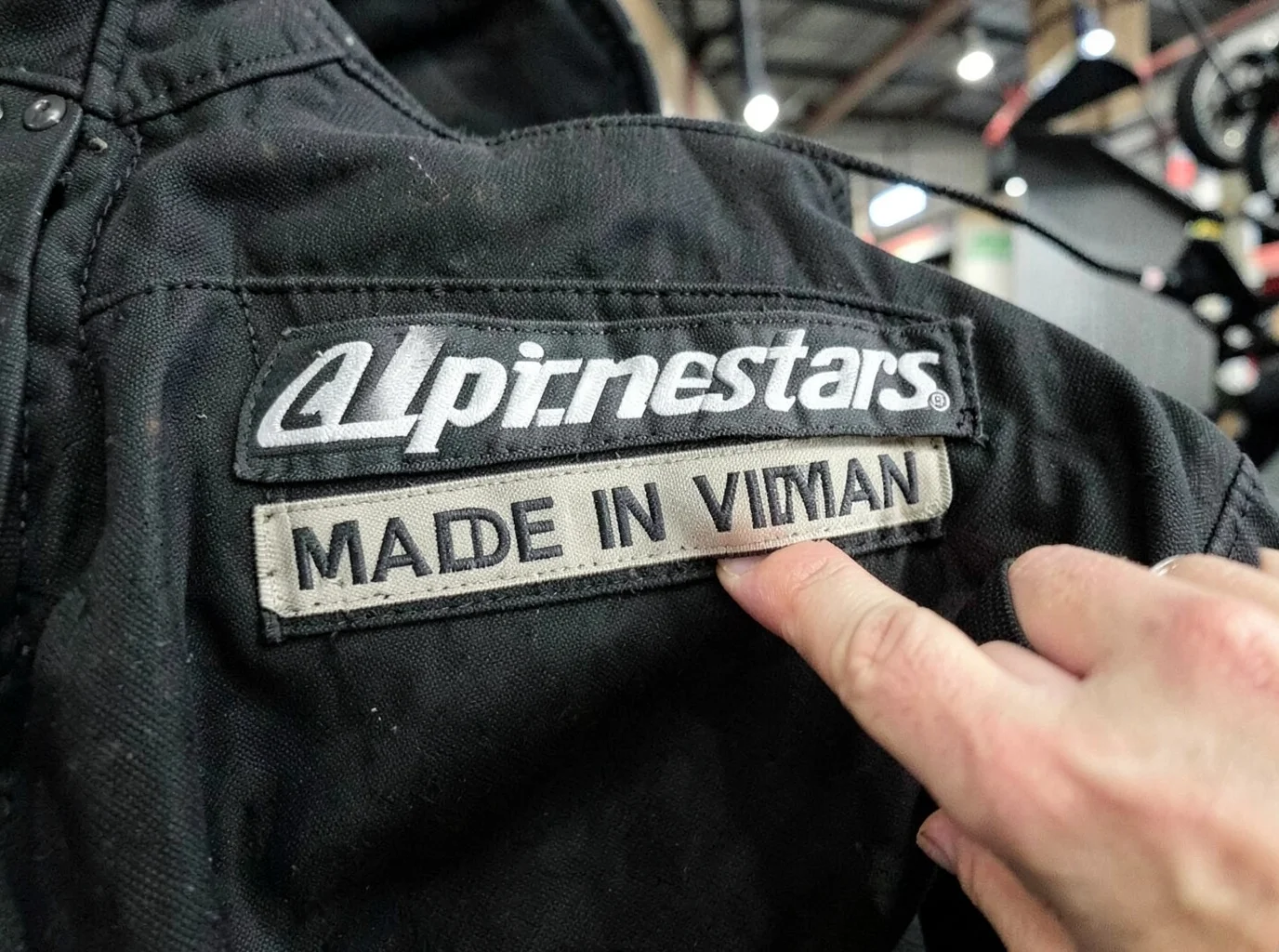
You just unboxed your new Alpinestars jacket, flipped back the collar to check the tag, and there it says "Made in Vietnam" or "China". That's not exactly what you pictured when you paid premium money for a brand built on Italian racing heritage.
Alpinestars manufacturing locations vary by product line. The country on your jacket depends on whether you're holding a GP-series leather race suit or a textile Airflow model. We'll break down exactly which factories produce which gear, show you how to decode the label and serial number yourself in under a minute, and explain why "Made in Vietnam" doesn't mean you got shortchanged. You're wearing the same production standard as Dainese and REV'IT!
Alpinestars brand history: Italian design, global production
Sante Mazzarolo started the company in 1963, from a small workshop in Asolo, Veneto, in Northern Italy. He was making leather hiking and ski boots back then, not racing jackets. The name comes from the Alpine star flower, a nod to the mountains around his shop.
Within a few years, Mazzarolo pivoted into motocross boots and off-road gear. The brand's DNA is leather craftsmanship, born in the mountains, built for people who fall down a lot and need their gear to survive it.
Alpinestars' Italian roots are in design and engineering. The stitching can happen anywhere.
The company's R&D and product development still run out of Northern Italy. That core hasn't moved. What has changed is the scale. Alpinestars now has roughly 700 employees across hubs in Los Angeles, Bangkok, Tokyo, and the original base in Northern Italy. The split is roughly 350 staff in Italy and 550 worldwide. Italy is a major hub in the operation, but not the whole thing.
In 1987, Alpinestars USA opened in Los Angeles. That pushed the company from an Italian specialist shop into a global motorsports company. Production had to follow the growth. Premium lines still lean on Italian craftsmanship. The broader catalog is built across Croatia, Thailand, Vietnam, and China — a pattern we'll break down model-by-model next.
Alpinestars Manufacturing Location: The Countries Found on Jacket Labels
Five countries show up again and again on Alpinestars jacket tags: Vietnam, Italy, Croatia, China, and Romania. That's the real geography behind the brand, not the marketing version.
Here's a concrete case. A retailer listing for the Faster V3 leather jacket shows the motorcycle jacket manufacturer address as "Alpinestars S.p.A., Viale E. Fermi 5, 31011 Asolo, Italy." That's the corporate HQ, the same town where Sante Mazzarolo cut his first boot leather back in 1963. But right below it, the country of manufacture reads Vietnam. The company address and the production address are two different things. That distinction trips up a lot of buyers who see "Italy" on the box and assume that's where the stitching happened.
Apparel Production Pattern by Region
Italy and Croatia — often tied to higher-tier apparel, closer to the design studio
Vietnam — a heavy hitter for leather jackets, including the Faster V3
China — common for mid-tier and entry-level textile pieces
Romania — shows up across seasonal apparel runs
None of this is fixed. A jacket model made in Vietnam this season could shift production to Romania next year, depending on capacity, tariffs, or factory contracts. Alpinestars doesn't lock a model to one country forever.
The label inside your jacket is the only source that matters for your specific unit. Skip the guesswork. Skip the assumptions based on what you read on a forum. Flip the collar, check the printed country of origin, and that's your answer verified, not assumed. We'll get into exactly how to decode that tag, plus the serial number next to it, in the section below.
Alpinestars Jacket Made In Vietnam or China: How to Read the Label
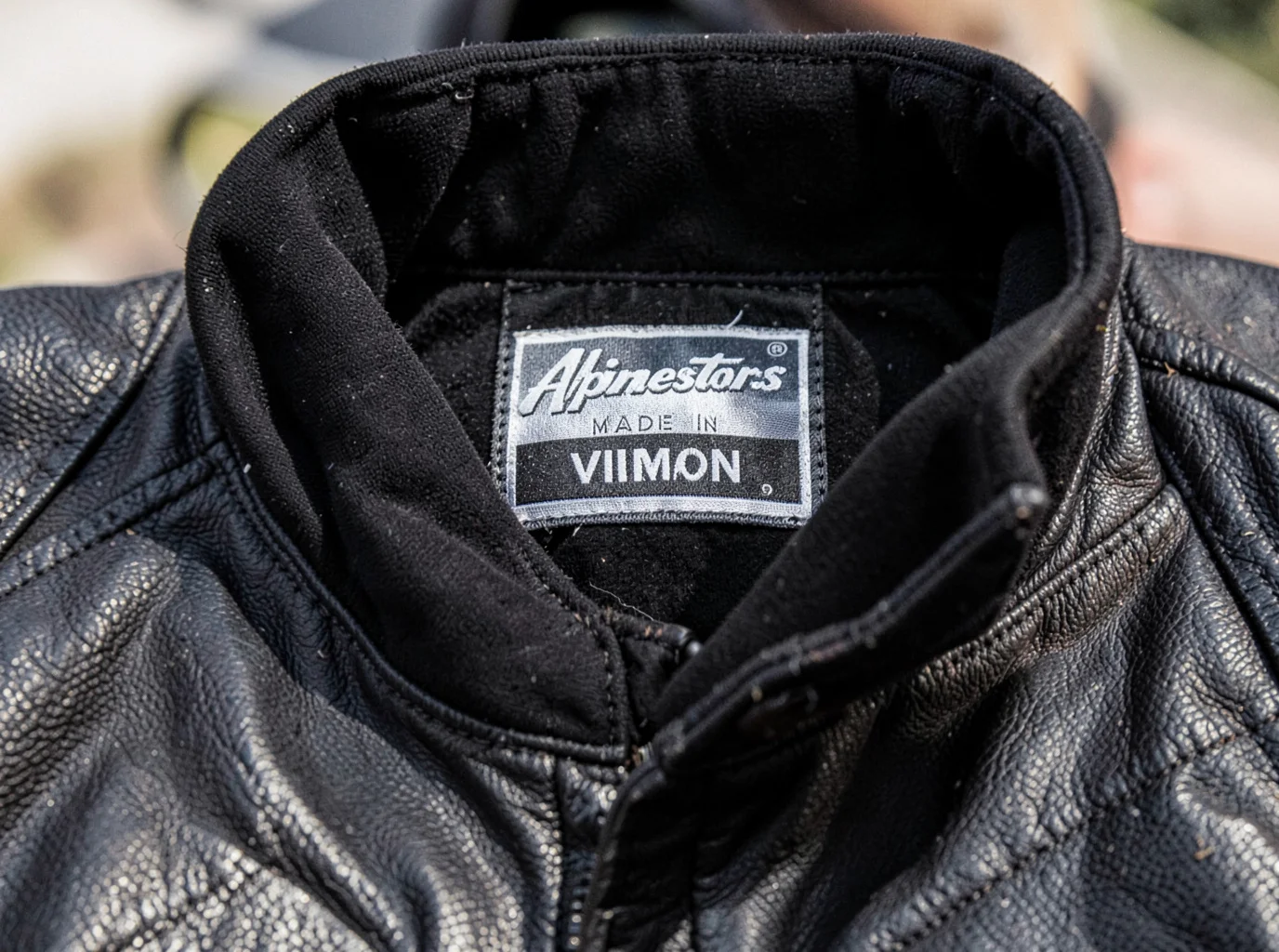
Seeing "Vietnam" or "China" stitched into your jacket tag isn't a red flag by itself. That's just how global apparel production works in 2024. What matters is whether the tag itself checks out.
You can run a full inspection in about 30 seconds.
1. Find the inside neck seam or side seam tag.
That's where the care and composition label lives, and where the country of origin gets printed. Ignore the box and the hang tag. The sewn-in label is the one that counts.
2. Read the brand spelling first.
It should say Alpinestars, one word with no space or hyphen. If you see "Alpine Star" or "Alpinestar" (missing the S), you're holding a counterfeit. This is the single fastest fake-detector on the entire garment.
3. Match the model name/code to the listing.
Every genuine jacket carries a specific model code on the internal tag. Cross-reference that code against the product page you bought from. If the code doesn't match the listing, the jacket isn't what you ordered.
4. Check the hardware.
Genuine Alpinestars gear runs YKK zippers. That's one of the first places cheap knockoffs cut corners, since YKK costs more per unit than generic hardware.
5. Inspect the stitching line.
The stitching should be clean and even, with no loose threads or skipped stitches. Sloppy seams on a jacket at premium prices are worth questioning.
A "Made in Vietnam" tag next to a legit model code, correct spelling, and YKK zippers means it's a real Alpinestars jacket.
Alpinestars Textile Jacket Made In: T-SPS, Chrome, and Airflow Models
Textile jackets tell a different manufacturing story than leather. Where the GP-series and Faster V3 lean heavily on Vietnam's leather craftsmanship, the touring and street lines shift toward poly-fabric construction, and that changes the production math.
T-SPS / T-SPS V2 Waterproof Jacket is built from 600D polyester with a dual polyurethane coating, a fully seam-taped waterproof membrane, and a detachable thermal liner. It's CE "A" certified, packing CE Nucleon Flex Plus armor at the shoulders and elbows, with slots for back and chest protection. Sizing runs XS–4XL, retailing around £149.99. It's a technical, multi-layer garment.
Airflow-family jackets, the T-GP Plus R V4 and the ventilated T-SPS Air V2, swap waterproofing for mesh panels and 450D–600D poly-fabric. These sit in the $219.95–$229.95 range at most retailers.
Chrome-style urban textile jackets land in a similar poly-fabric-plus-liner category, priced roughly $180–$250.
No public product sheet nails down an exact country stamp for these specific models. But the pattern across similar Alpinestars textile jackets in retail listings points consistently to Made in Vietnam. Same sourcing logic as the leather side. Check your own tag for the final word.
Alpinestars Leather Jacket Production: GP and Caliber Series
Race-grade leather isn't cheap, and Alpinestars prices the GP and Caliber lines to match. The Caliber Leather Jacket costs €589.95 MSRP on the EU store. At retailers you'll find it for €475.96–€559.95, a normal 10-20% street discount. It comes in black, sizes EU 46–60, built from 1.0–1.2mm premium leather. That's thick enough to matter in a slide.
The GP Force V2 costs €489.95, and it's the cleanest benchmark for the GP series right now. It's CE-certified AA class under EN17092, made from premium soft bovine leather, and Tech-Air ready – the chest and back pockets accept airbag-system inserts.
Armor specs on both jackets: On the Caliber, you get CE Level 1 GP-R shoulder and elbow armor plus an External DFS shoulder slider. The GP Force V2 uses Nucleon Flex Plus Level 1 shoulders, Nucleon PLASMA Plus Level 1 elbows, and GP Lite Evo DFS shoulder protectors.
Both jackets accept divided chest protectors and back inserts. That's race-spec construction regardless of which factory stitched it.
Alpinestars Motorcycle Jacket Factory: What Is Publicly Known About Factory Types
No public document names an exact Alpinestars factory. No street address, no OEM motorcycle jacket partner name, no per-facility certification list. That's the honest answer, and anyone who claims otherwise is guessing.
Across motorcycle jacket supplier analyses and retailer disclosures, one pattern keeps repeating. Alpinestars runs a distributed manufacturing model, not a single jacket factory pumping out every product line. Design and R&D stay anchored in Northern Italy, backed by corporate offices in Los Angeles and Tokyo. Production splits by tier: Italy and Croatia handle apparel positioned as premium, while Thailand, Vietnam, and China cover the broader catalog where cost and scale matter more.
Jacket category plays into this too. Alpinestars sells leather, textile, racing, adventure, and waterproof styles, and construction specs shift accordingly. One leather jacket lists 1.0–1.2mm bovine leather for the abrasion-resistance-to-weight balance. Casual sportswear jackets skip CE armor entirely; riding jackets don't.
Alpinestars Manufacturing Process and Quality Control Across Countries
Spreading production across five countries only works if there's one rulebook everyone follows.
Alpinestars runs a UNI EN ISO 9001-controlled quality management system that applies to every factory. Kompass lists ISO 9001:2015 and ISO 14001:2015 certifications for Alpinestars S.p.A. at the Asolo headquarters. Those two certifications cover quality management and environmental management at the corporate level. Alpinestars sets that standard in Italy and enforces it at every partner factory in Vietnam, China, Croatia, or Thailand.
Incoming material testing checks leather, poly-fabric, and hardware before production starts. In-process inspections happen mid-build, not just at the end. Finished-product testing verifies durability, abrasion resistance, tear strength, seam strength, closures, and protective elements.
Helmets carry ECE 22-06, ECE 22-05, or FIM FRHPhe-02 homologation. Boots meet EN 13634. Protective gear across the jacket lines carries CE certification. None of that changes based on which country stitched the piece.
If you're vetting a jacket, the country of origin tells you where it was assembled. The certifications tell you whether it passed the same bar as everything else in the catalog. Ask for both when you're unsure, not just one.
30-Second Alpinestars Jacket Authenticity Check
30-Second Alpinestars Jacket Authenticity Check
Six checkpoints separate a real jacket from a warehouse knockoff, and none of them require a lab.
For zipper branding, genuine hardware has engraved pulls. For internal labels, look for EN 17092 (A, AA, or AAA class) and EN 1621-1/1621-2 stamped on armor inserts. A jacket claiming CE certification with unmarked protectors is lying. Armor inserts sit firm and contoured. Stitching at shoulders and elbows is reinforced double-stitching. Loose threads or single-stitch seams in stress zones are counterfeit tells. For seller legitimacy, extreme discounts, "inspired by" wording, or vague origin listings are red flags. Buy authorized. To confirm a serial number, email [email protected] and reference the corporate address Viale E. Fermi 5, 31011 Asolo (TV), Italy.
Here is the improved version of your text, following all the specified formatting and style requirements.
Alpinestars supply chain review
Company background
Alpinestars, a global leader in performance apparel, footwear, and motorsport protection, has recently faced criticism regarding supply chain transparency. Reports have emerged of potential labor violations, including forced labor, human trafficking, and child labor, within their supply chain.
Code of ethics
On November 22, 2021, Alpinestars published its Code of Ethics, mandating that all employees, contractors, and motorcycle jackets suppliers comply with applicable laws. The code explicitly prohibits forced labor, human trafficking, and child labor.
QHSE policy
Alpinestars' QHSE policy reinforces these standards, requiring all employees and motorcycle jacket suppliers to follow applicable laws and regulations. The company has also implemented a sustainable supply chain policy, obligating suppliers to meet environmental and social standards.
Supply chain data
Alpinestars' supply chain data for the fiscal year reveals 69 shipments from 14 motorcycle jacket suppliers across 6 countries. Most shipments originate from Vietnam, reflecting the company's significant footwear manufacturing footprint there.
Compliance performance
Alpinestars achieved a 81/100 compliance score across its supply chain, with zero sanctions and zero forced-labor flags during the reporting period.
Tier-1 suppliers
Among the tier-1 motorcycle jacket suppliers, Pouyena Vietnam accounted for 21 shipments and Minson Thailand for 12 shipments, highlighting the concentration of Alpinestars' supply chain in Southeast Asia.
Environmental gap
One notable gap remains: Alpinestars does not yet track or report Scope 1, 2, or 3 emissions data. The company has not yet pursued B-Corp certification, which would require comprehensive emissions reporting.
Alpinestars Country of Origin Versus Dainese, REV'IT!, and Spidi
Every major motorcycle gear brand plays the same game Alpinestars does. Compare the labels side by side, and "Italian brand, Asian factory" is standard industry practice.
The brand-origin lineup:
Alpinestars: Italian, founded 1963 in Asolo by Sante Mazzarolo
Dainese: Italian, founded 1972 in Molvena, headquartered near Vicenza
Spidi: Italian brand identity, the closest comparison point to Alpinestars and Dainese
REV'IT!: Dutch, founded 1995 in Oss by Ivan Vos, not Italian at all
Three out of four "Italian moto gear" brands you trust aren't fully manufactured in Italy.
Manufacturing footprint:
Alpinestars spreads production across Croatia, Thailand, Vietnam, and China
Dainese leans on Vietnam and Tunisia for mass production, keeping high-end custom pieces closer to home
REV'IT! runs premium race suits through TAILORTECH in Marostica, Italy, while assembling other gear in Asia
Spidi follows the same Italian-moto pattern: some domestic runs, outsourced production elsewhere
Alpinestars is the norm. Check any competitor's tag, and you'll find the same split between design heritage and production geography.
Conclusion
The "Made in Italy" myth was never the point—performance and protection were. Your Alpinestars jacket's country of origin, whether a GP leather piece stitched in Vietnam or a T-SPS textile shell assembled in Indonesia or China, reflects deliberate engineering decisions made in Asti. Italian R&D, race-team feedback, and factory-specific certification drive the process, no matter which country stamps the label.
Pull that jacket off the hanger. Check the label and run the 30-second authenticity check. Cross-reference the serial number if anything feels off. If doubts linger, email Alpinestars support directly with your model number—they'll confirm production details.
Dainese, REV'IT!, Spidi—they all play the same game. Origin isn't the risk. Skipping verification is.