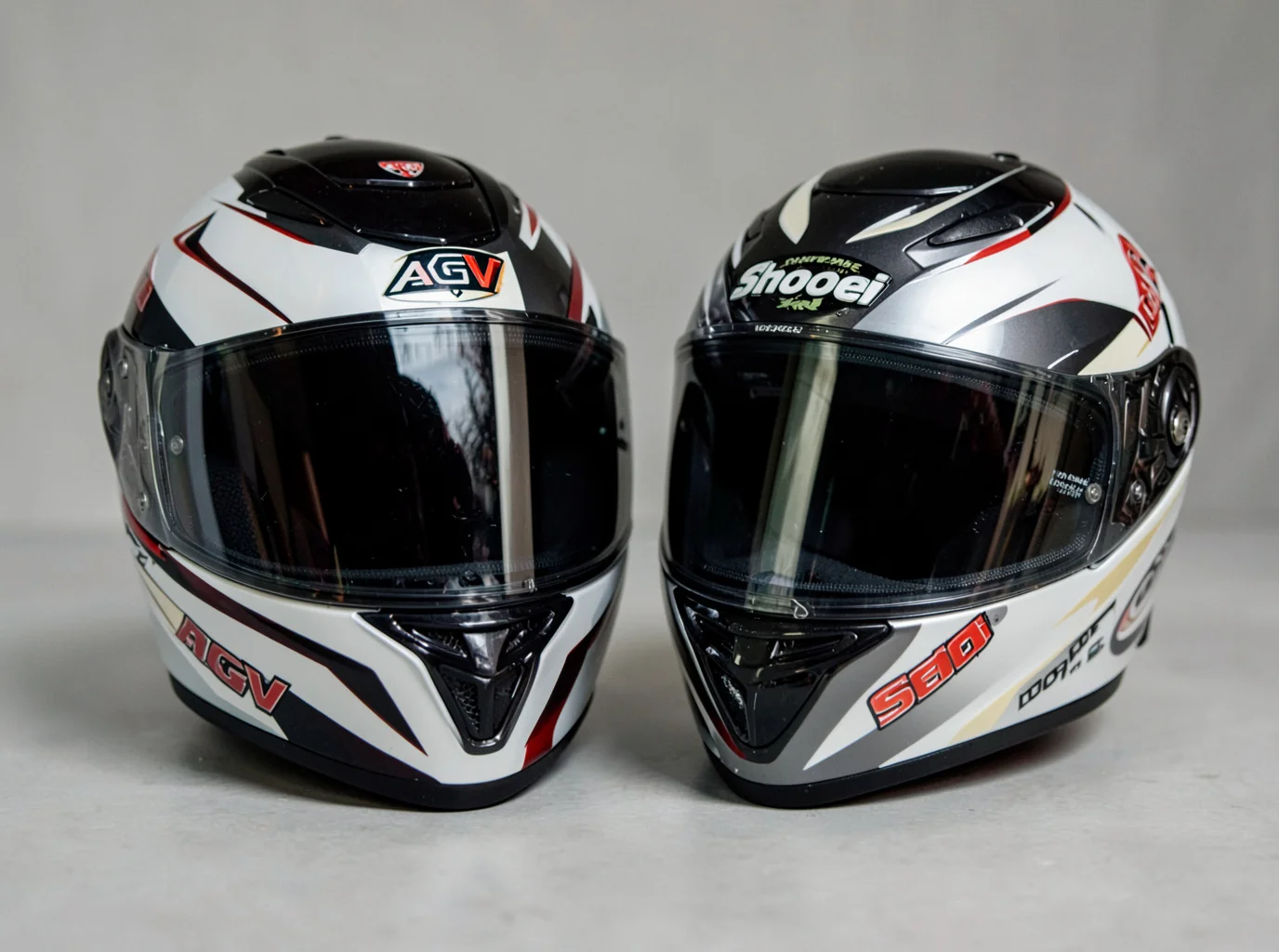
You've narrowed it down. Two helmets sit in your cart, both premium and trusted by racers and daily riders alike, yet you still can't click "buy." That hesitation makes sense. AGV and Shoei solve the same problem in opposite ways. One leans into aggressive, track-bred aerodynamics; the other into quiet, all-day comfort. Hard numbers like SHARP ratings, decibel levels, gram-for-gram weight distribution, and the shape of your skull tell the difference.
This comparison skips the brand history lesson. Brands can also explore custom motorcycle helmet options for specific market requirements.You'll see how the AGV Pista GP RR stacks up against the Shoei X-Spirit III on a closed circuit, how the Shoei RF-1400 handles a six-hour highway slab, and which helmet fits your head shape.
AGV Pista GP RR vs Shoei X-Spirit III: Which Race Helmet Wins on Track?
The "better race helmet" and the "more homologated race helmet" aren't the same thing. That distinction settles most of the AGV vs Shoei debate on track.
The AGV Pista GP RR is a 100% carbon fiber shell. It carries ECE 22.06 certification plus full FIM homologation—the current gold standard for competition use. Weight sits around 1450g (+/- 50g) in the first shell size, spread across four shell sizes. Closure is a titanium double D-ring. Ventilation runs 5 intake and 2 exhaust ports. Street price typically lands between €700–€900+ Motorcycle Helmet, sometimes higher depending on edition.
The Shoei X-Spirit III uses Shoei's AIM+ composite shell instead of carbon. Certification is ECE 22.05 with SNELL M2020 backing in most listings. Weight commonly shows up around 1350g, with size L variants closer to 1433g—roughly 100g lighter than the Pista GP RR in most published comparisons. Ventilation jumps to 6 intake and 6 exhaust ports, nearly double the airflow paths. Pricing sits around €647.10+, often ranging €640–€800.
What Actually Wins Under Race Conditions
Weight : X-Spirit III's ~100g savings reduces neck fatigue across long sessions. On a 20-minute track day, that adds up.
Certification : Pista GP RR's ECE 22.06 + FIM stack is the stronger pure-racing credential.
Shell material : Full carbon on the Pista GP RR beats AIM+ composite on race-premium construction.
Ventilation : X-Spirit III's extra vents help more on hot track days.
Aerodynamics : X-Spirit III uses vortex generators and stabilizers; Pista GP RR focuses on rotational-acceleration reduction.
Choose the Pista GP RR for flagship race hardware and current homologation. Choose the X-Spirit III if you want a lighter, better-ventilated helmet that holds up session after session. For raw track comfort, the X-Spirit III edges ahead. For race-spec bragging rights, the Pista GP RR wins.
Track helmets get the glory. Commuter helmets get the daily grind. When you compare these two for everyday riding, you're really asking how they feel after hour four.
The AGV K6-S weighs about 1,255g on AGV's spec sheet, though some retail listings show closer to 1,220g depending on size. The Shoei RF-1400 comes in at 3.64 lb, roughly 1,651g. That 400g gap is small on paper but significant on your neck after three hours of stop-and-go traffic.
Build and certification differ too. The K6-S uses a carbon-aramid fiber shell, certified ECE 22.06/DOT (E2206). The RF-1400 uses Shoei's Multi-Ply Matrix AIM+ shell, certified Snell M2025D and DOT-218. The K6-S gives you a 190° horizontal, 85° vertical field of view with a Pinlock 120XLT MaxVision insert included. The RF-1400 pairs a Dual Density EPS liner with the 3D Max-Dry System II, and it's built for an intermediate oval head shape.
Best for Daily Commuting
The K6-S wins on fatigue management. Lighter weight plus a wider eye port makes constant head checks and lane changes less taxing. If your commute involves heavy traffic and frequent stops, that weight savings adds up fast.
The RF-1400 wins when your commute is mostly highway. Riders consistently praise its stability and ventilation, though one long-term test noted it runs slightly noisier than expected at highway speeds.
Best for Long-Distance Riding
For multi-hour rides where cumulative fatigue is the enemy, the K6-S's lighter shell keeps neck strain lower mile after mile.
For sustained 65–85 mph cruising, the RF-1400's heavier, more substantial shell and Snell-rated certification give you a steadier, more premium touring feel.
The K6-S starts around €292.50 Long-Distance Riding helmet in EU retail (about $599 in US listings), while the RF-1400 typically runs $80–$150 higher in comparison reviews.
AGV vs Shoei Safety Rating: SHARP, ECE, and SNELL Data Compared
Numbers don't lie, but they need context. Both brands average 4.3 out of 5 stars on SHARP. That tie makes the headline number useless. The breakdown shows why.
AGV has 14 of 35 rated models at 5 stars. Shoei has 9 of 19 rated models at 5 stars, with zero models scoring below 3 stars. Shoei's hit rate for top scores is slightly higher percentage-wise: 9 out of 19 versus 14 out of 35, even though AGV has more total 5-star helmets.
ECE 22.06: The Newest Standard, Tested Head-to-Head
Look at the most recent ECE 22.06 models, which is the current safety benchmark, and the results are clean.
AGV's ECE 22.06 lineup has all 5 stars (3 of 3). Shoei's ECE 22.06 lineup has all 5 stars (4 of 4).
Perfect scores on both sides. Under the newest testing protocol, neither brand has a weak link. The Neotec 3 scores 97% chin bar closure integrity, a detail that matters if you ride modular.
SNELL: The One Real Difference
The brands split here. Shoei offers SNELL M2025D or M2020 certification on select models, layered on top of DOT and ECE 22.06. AGV skips SNELL entirely and stays ECE-focused.
If SNELL certification matters to you, and it's common among track-day riders who want an extra safety layer beyond ECE, then Shoei is your only option between these two brands.
AGV vs Shoei Helmet Noise Level, Ventilation, and Highway Comfort
Decibels don't lie. At highway speed, the Shoei X-Fifteen runs about 3-4 dB quieter than the AGV Pista GP RR above 80 mph. That gap sounds small until you're four hours into a ride and your ears are ringing.
The AGV K6 S measures around 98-101 dB at highway speed. The Shoei GT-Air 3 and RF-1400 land in the 97-98 dB range—consistently the quieter pick, helmet after helmet. One road test recorded the RF-1400 at 82 dB at 70 mph, versus 88 dB on a cheaper competitor. That's a measurable difference in fatigue over distance.
Ventilation is a different story. AGV favors aggressive, lighter-feeling airflow. Shoei balances airflow with sealing. The X-Fifteen packs 7 intakes and 6 exhausts with deep EPS channels—strong airflow without losing the quiet.
The pattern holds across the lineup:
AGV : lighter, better airflow, more wind noise on long highway stretches
Shoei : quieter, better sealed, more stable at speed
Pick Shoei for noise reduction and highway touring. Pick AGV for airflow and a lighter, race-oriented feel—knowing you trade off some quiet. Earplugs help either way, but Shoei wins the quiet-highway argument on data alone.
AGV vs Shoei Helmet Fit and Comfort for Different Head Shapes
Your skull shape matters more than your brand loyalty. Buy the wrong fit and even a 5-star SHARP helmet will give you a headache by lunch.
AGV runs intermediate oval-to-round. That profile forgives a wider range of head shapes, which is why AGV is often the safer pick if your head runs rounder than average. Shoei runs intermediate oval—longer front-to-back, narrower side-to-side—and stays more consistent across its lineup than AGV does.
Fit Rules That Actually Matter
AGV sizing : 53–54cm (XS) up to 63–64cm (XXL). AGV's own guidance: the helmet should pull skin on your cheeks and forehead. If you're between sizes, size down.
Shoei sizing : 53cm (XS) up to 63cm (XXL), measured the same way—widest point, just above the eyebrows.
Pressure points : Shoei's P.F.S. (Personal Fitting System) lets a dealer measure your head and prescribe padding adjustments in the upper-head area. AGV offers no equivalent Motorcycle gear factory fitting service.
Model-Level Exceptions
Not every model follows the brand pattern. Shoei's Neotec 3 fits longer oval heads better than most Shoei helmets. Some AGV sport models run tighter through the chin and temples than the brand's general profile suggests.
Rounder head? Start with AGV. Consistent oval shape, or you want dealer-tuned precision? Shoei's P.F.S. gives you a fix AGV can't match.
AGV vs Shoei Price Comparison: What the Extra Money Buys
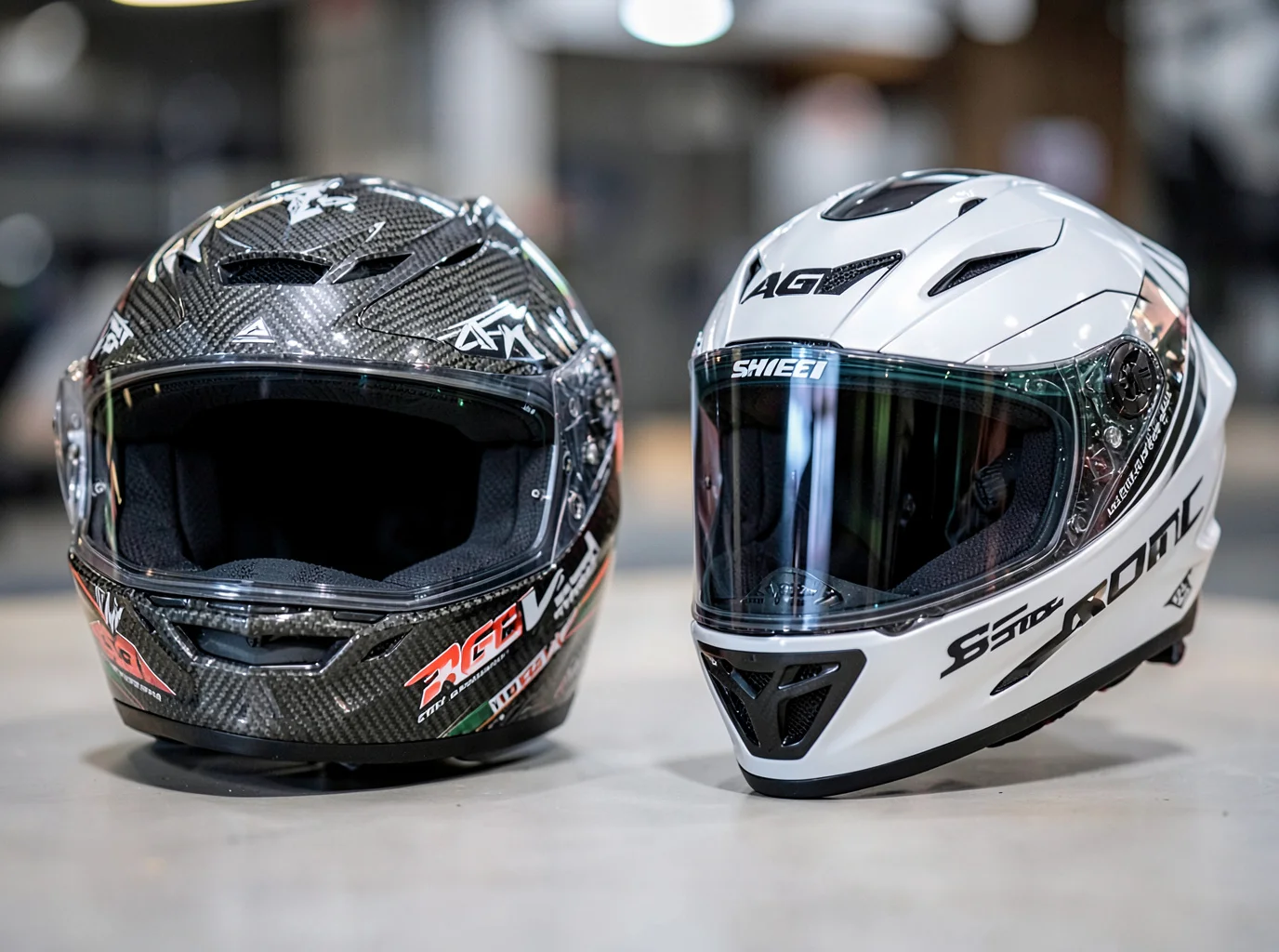
Motorcycle Helmet Price tags tell a story if you know how to read them. The AGV K6 S has a $639 MSRP in the US. The Shoei X-Fifteen runs $979.99–$999.99. That's a $340–$360 gap between helmets that both protect your skull well.
Look at the midrange instead. The AGV K6 S sells for $338–$529 in EU listings. Shoei's NXR 2 lands around €299.99–€599. At discounted pricing the gap shrinks to €7–€50.
The AGV K6 S weighs 1,255g with a carbon-aramid shell—lighter weight per dollar spent. The Shoei NXR 2 is heavier at 1,392g with an AIM+ composite shell, but priced closer to the AGV. At the top end, the Shoei X-Fifteen costs $980–$1,000 and is Shoei's race-focused flagship. The AGV Pista GP RR runs $1,200+ and is AGV's premium race lid.
AGV's extra dollars buy lighter shells. Shoei's extra dollars buy flagship race pedigree.
Shoei or AGV Helmet: Scenario-Based Decision Tree
Your riding scenario determines the right helmet. Match yourself to one of these five profiles, and the choice becomes obvious.
Track day, full tuck, aero-first: Pick the Shoei X-SPR Pro for its ECE 22.06 certification with FIM backing. Pick the AGV Pista GP RR if you want AGV's race flagship—same FIM status, proven styling, though listed under ECE 22.05 in some 2026 comparisons.
Daily commuting, weight matters most: Go AGV K6 S. At 1,220g, it's roughly 430g lighter than the Shoei RF-1400's 1,650g. That's real fatigue savings on a 45-minute commute.
Long-distance touring, quiet and premium: Choose the Shoei GT-Air 3 (1,540g, ~$730 motorcycle helmet) or RF-1400. Shoei owns this category outright.
Budget-limited buyer: The AGV K1 Mono at $209.95 beats every Shoei option. RF-1400 starts at $549.99+. Skip Shoei here entirely.
Best all-rounder for most riders: AGV K6 S wins on price-to-weight ratio. Shoei RF-1400 wins if you'd rather pay more for a proven premium sport-touring lid.
Conclusion
The best custom motorcycle helmet for you depends on your head shape and riding style. The AGV Pista GP RR dominates on track with sharper aerodynamics and a race-tuned fit for narrower, rounder heads. The Shoei RF-1400 wins the highway, wrapping quieter, more forgiving comfort around long ovals mile after mile. SHARP scores, SNELL certifications, and decibel readings back this up.
Skip the endless brand debates. Match your riding style and head shape to the numbers above, and the decision makes itself in seconds.
Before you buy, try both models on if you can—fit trumps spec sheets every time. Then commit, ride, and stop second-guessing.